Two of our primary tools for maintaining control when developing customizations for our customers are GitHub and SuperOffice Service, and here I’ll briefly describe how we’ve used CRMScript to create a light integration between the 2 systems.
If you’re new to CRMScript, check out the fundamentals.
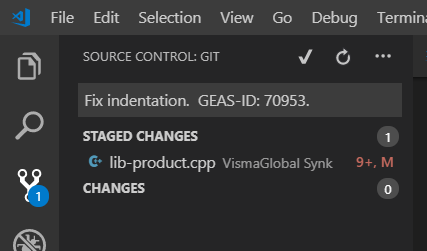
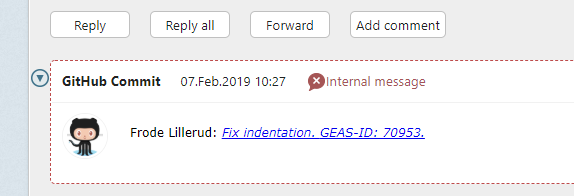
The jist of it is that whenever we commit code to GitHub, we can optionally include a Ticket ID in the commit message, and this will create a message in our SuperOffice.So a commit like this:Generates this on the correct ticket:The first step is to create a web service in SuperOffice with a script similar to this:
#setLanguageLevel 3;#include "lib-http";#include "lib-ticket";/* * Webservice which listens for webhooks from GitHub. * If the commit contains 'GEAS-ID: 12345', then a message is added on that ticket. * Frode, 7.des 2018 *///Configuration startInteger replyTemplateId = 82;Integer personId = 92618; //Person "GitHub Commit" on company "GitHub".//Configuration endstruct GitHubUser { String name; String email; String username;};struct GitHubCommit { String url; String message; GitHubUser author; GitHubUser committer;};struct GitHubInfo { GitHubCommit[] commits; String toJson() { JSONBuilder jb; this.toJson(jb); return jb.getString(); } Void fromJson(String json) { this.fromXMLNode(parseJSON(json)); }};//Load the incoming JSON data into a struct.String data = getCgiContent();GitHubInfo info;info.fromJson(data);//Find our static GitHub person.NSPersonAgent personAgent;NSPerson person = personAgent.GetPerson(personId);//Does the commit contain a ticket ID?for (Integer i = 0; i < info.commits.length(); i++) { //String contains 'GEAS', then maybe a dash, then 'ID', then maybe ':', then maybe a whitespace, then a number which is 5 or 6 chars long. String pattern = "GEAS-?ID:?\\s?([0-9]{5,6})"; String[] matches = info.commits[i].message.regexp(pattern); if (matches.length() >= 2) { //Found a ticket ID. Integer ticketId = matches[1].toInteger(); ReplyTemplate r; r.load(replyTemplateId); Parser p; p.setVariable("committer", info.commits[i].committer.name); p.setVariable("message", info.commits[i].message); p.setVariable("url", info.commits[i].url); p.setVariable("data", data); String body = p.parseString(r.getHtmlBody(-1)); Message m = CreateDefaultMessage(ticketId); //m.setValue("createdBy", users.get(info.commits[i].author.username)); //m.setValue("customer_id", personId.toString()); m.setValue("customerId", personId.toString()); m.setValue("bodyHtml", body); m.setValue("slevel", "1"); //internal m.setValue("author", person.GetFullName()); // info.commits[i].author.name; m.save(); }}return Ok();
Remember to wrap the script in the appropriate EJSCRIPT start and end tags
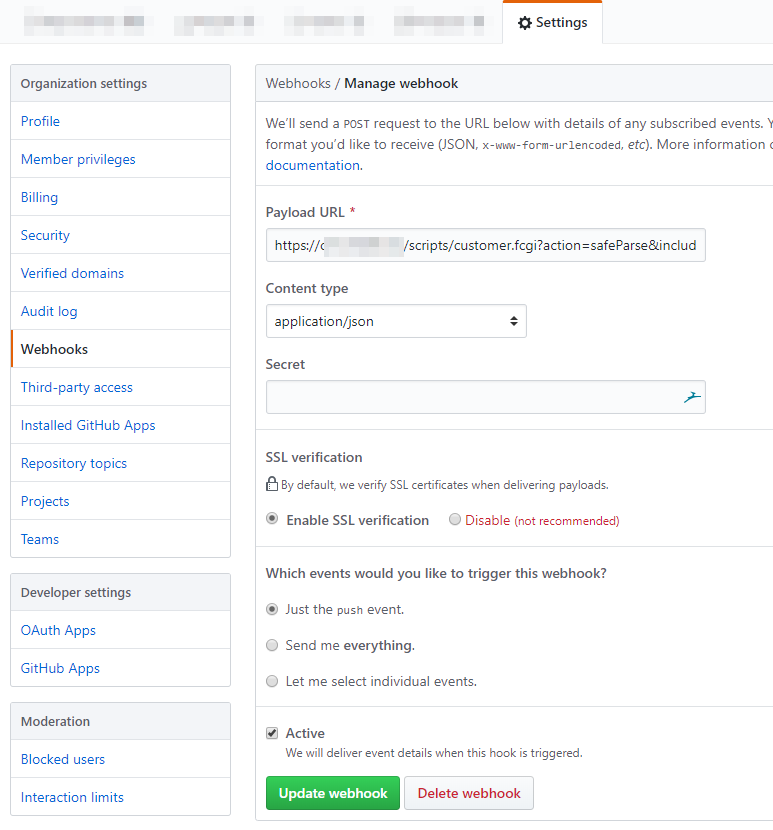
The 2 includes can be found in the SuperOffice CRMScript repo.The next step is to tell GitHub to post JSON to SuperOffice whenever a commit happens.We’ve set the setting on the GitHub organization level by going to Settings and the WebHooks settings. Create a webhook there that points to the script.The URL looks like this:https://crm.example.com/scripts/customer.fcgi?action=safeParse&includeId=github-webhooks-all&key=secretAnd from then on all commits that contain the magical ID reference will end up as messages in SuperOffice.


 Generates this on the correct ticket:
 The first step is to create a web service in SuperOffice with a script similar to this:
 The URL looks like this: